The Sopranos
Inspired by Tony Soprano
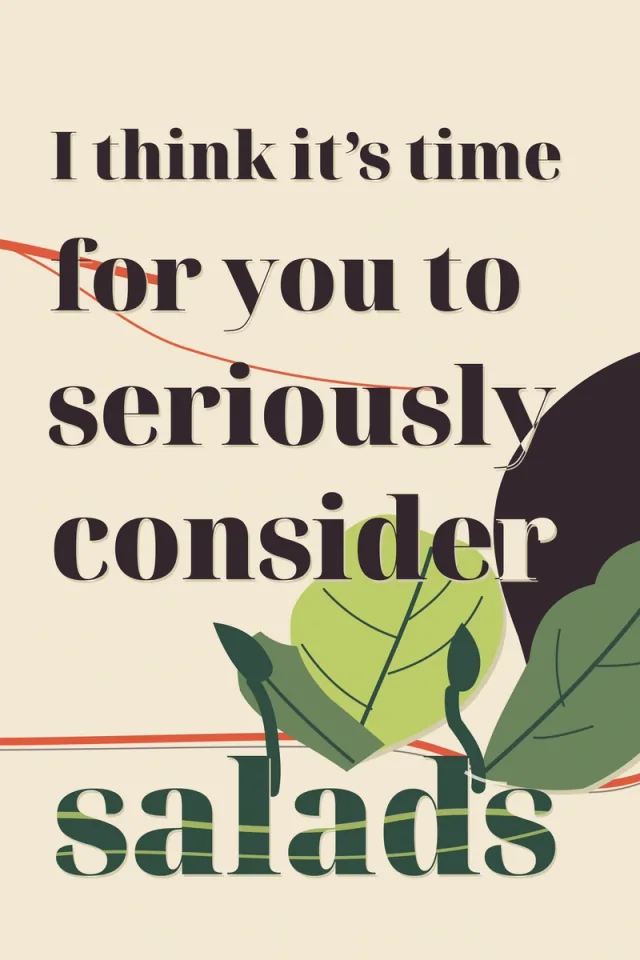
“I think it’s time for you to seriously consider salads”
Leaf and plate
Green salad leaves and curved lines around dark serif lettering, adapting Tony's blunt dietary quip.
The prints
Start with a show or comedian you love, or a line you still repeat. Find the artwork you’ll be glad to see every day.
Find your favorite quote →Inspired by Tony Soprano
Leaf and plate
Green salad leaves and curved lines around dark serif lettering, adapting Tony's blunt dietary quip.

Spoken by Artie Bucco
Data machines
Retro computer terminals and red-green data marks on cream, framing Artie Bucco's pompous lecture at Vesuvio.

Spoken by Artie Bucco
The printed world
A green dotted world map and unspooling printout framing Artie Bucco's awkward warning at Vesuvio.
Inspired by Cosmo Kramer and Medical Receptionist
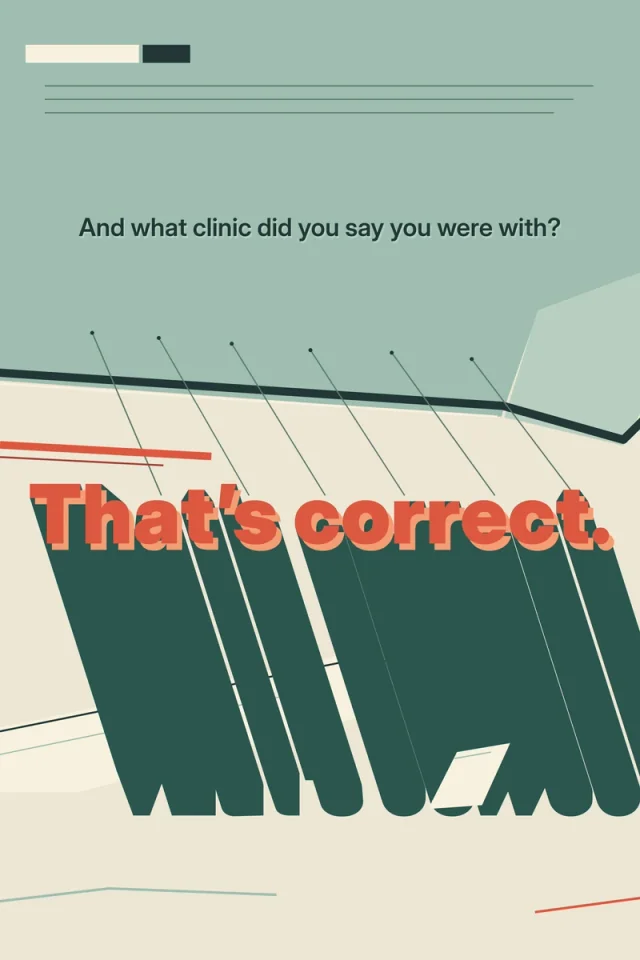
The clinic form
A stylized teal medical form and coral lettering, capturing Kramer's shameless doctor bluff in The Package.

Inspired by Cosmo Kramer and Medical Receptionist
The corridor
Converging corridor shapes and a coral circle framing Kramer's confident medical bluff in dark green and cream.

Spoken by Ralph Cifaretto
The red silhouette
A red gesturing silhouette and slanted black lettering on cream, capturing Ralph Cifaretto's vain deflection.

Spoken by Jiffy Dump attendant
Wall and trash bag
Oversized cream lettering on an orange wall beside a trash bag, capturing the dump attendant's flat brush-off.

Spoken by Lieutenant Bookman
The wagging finger
A pointing finger, tan jacket, and red tie on blue, channeling Bookman's ferocious library lecture.

Spoken by Lieutenant Bookman
The faceless suit
A suited detective silhouette framed by angular parchment shapes, honoring Bookman's serious speech to Kramer.

Spoken by Corrado “Junior” Soprano
The detective’s desk
Gold lettering across a book with reading glasses in warm shadow, capturing Uncle Junior's impatient phone put-down.
Inspired by J. Peterman
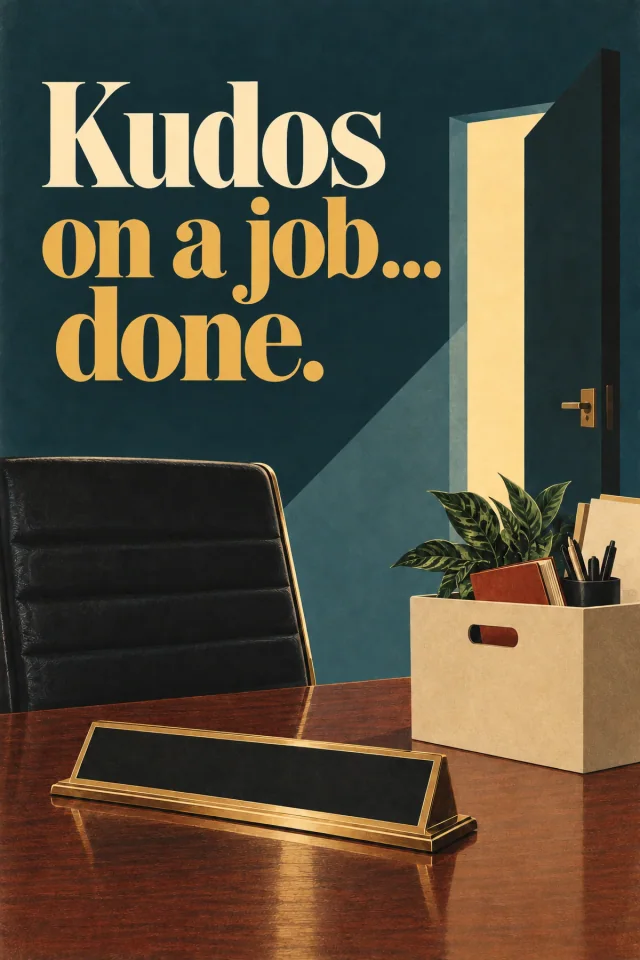
open door office
Peterman's return in Seinfeld’s “The Money” ends Elaine’s temporary presidency. His congratulations stop short of actual praise. The empty executive chair, blank nameplate and open doorway translate withdrawn authority into a dry workplace anticlimax. This name-free wording is an intentional adaptation.

Spoken by Cosmo Kramer
steam and coast
Cosmo Kramer in Seinfeld’s “The Keys”: At the coffee shop, Kramer interrupts ordering, moves beside George and asks whether he yearns. George distinguishes his constant cravings from yearning. Kramer challenges George’s lack of prospects before announcing his own intended move to California. Coffee steam climbs into the descending y while a distant road echoes its curve. The illustration interprets the exchange rather than recreating its literal staging.

Spoken by Jerry Seinfeld
stationary track
Jerry Seinfeld in Seinfeld’s “The Race”: Jerry’s legendary speed came from an unnoticed premature start in a school race. Rather than risk exposing it, he refuses subsequent races. His principled-sounding refusal protects a reputation whose basis the audience knows is accidental. Stationary back-view man refuses the empty track's forward perspective. The illustration interprets the exchange rather than recreating its literal staging.
Dialogue: Carmela Soprano; later repeated by Tony Soprano
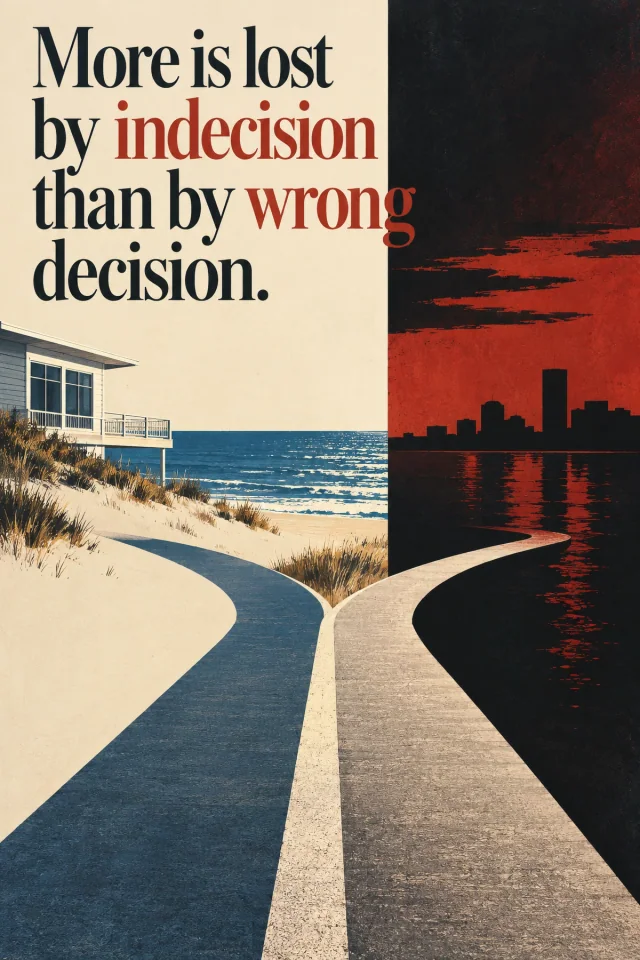
divided stakes
Carmela Soprano; later repeated by Tony Soprano in The Sopranos’s “Whitecaps”: Carmela invokes the maxim while urging Tony to decide on the beach house. Tony subsequently repeats it during his conversation with Johnny Sack about the proposed killing of Carmine. The same business-like advice migrates from domestic purchasing to a lethal decision. One path splits toward an attractive beach house and a red-black urban horizon. The illustration interprets the exchange rather than recreating its literal staging.

Spoken by Tony Soprano
blocked departure
Tony Soprano in The Sopranos’s “Chasing It”: Marie seeks money to move her family to Maine because Vito Jr. is struggling after his father’s death. Tony dismisses relocation with therapeutic-sounding language. His gambling and money pressures complicate the apparently helpful advice; the family later receives a punitive alternative rather than the requested fresh start. Packed case faces a concrete roadblock below a northeastern map. The illustration interprets the exchange rather than recreating its literal staging.
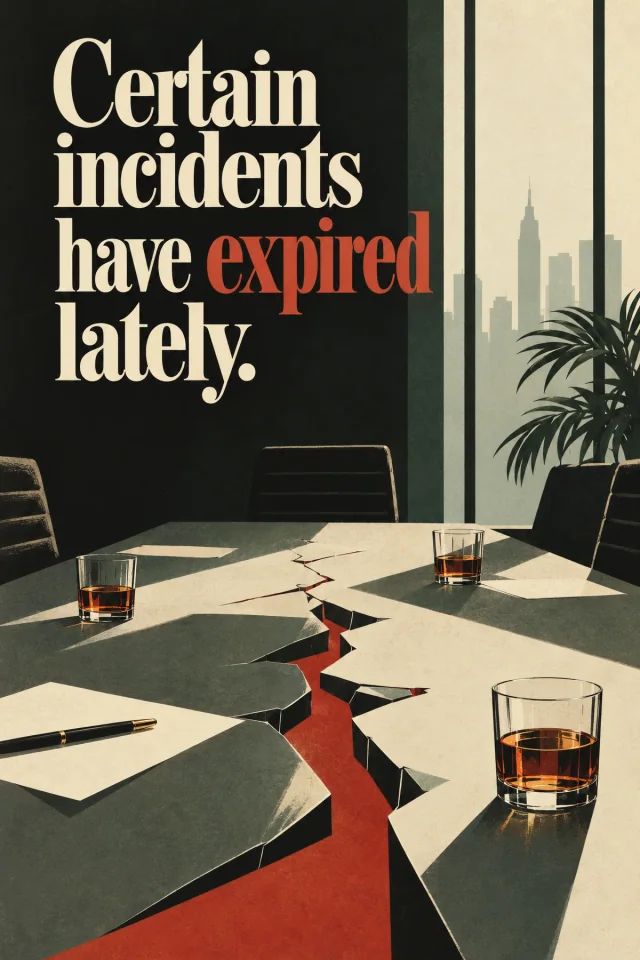
Spoken by Little Carmine Lupertazzi
fractured meeting
Little Carmine Lupertazzi in The Sopranos’s “Kaisha”: Little Carmine mediates escalating retaliation between Tony and Phil, including the destroyed wire room. He dresses the meeting in business language and uses a malapropism in place of a clear description of recent incidents. His attempt to minimize conflict later falters when he mentions Phil’s brother. A red fracture divides a meeting table while wording claims expiry. The illustration interprets the exchange rather than recreating its literal staging.
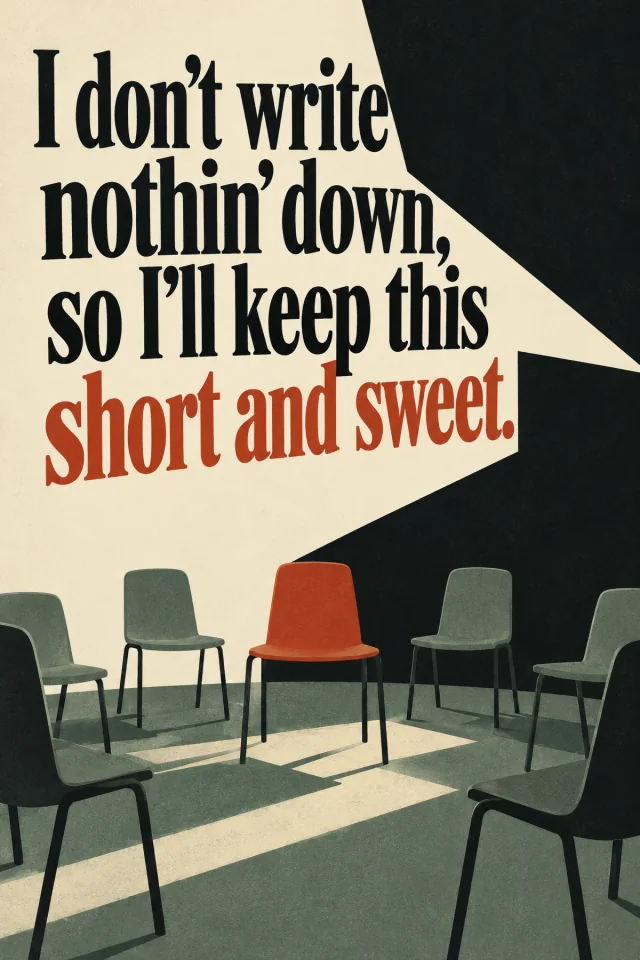
Spoken by Silvio Dante
pointed intervention
Silvio Dante in The Sopranos’s “The Strong, Silent Type”: During Christopher’s intervention, the facilitator asks participants to read prepared statements. Silvio has written nothing and announces brevity before bluntly calling Christopher weak, out of control and an embarrassment. It is a confrontational contribution in a setting intended for structured support. An oversized pointed speech form dominates an intervention-like circle of empty chairs; one chair is red. The illustration interprets the exchange rather than recreating its literal staging.
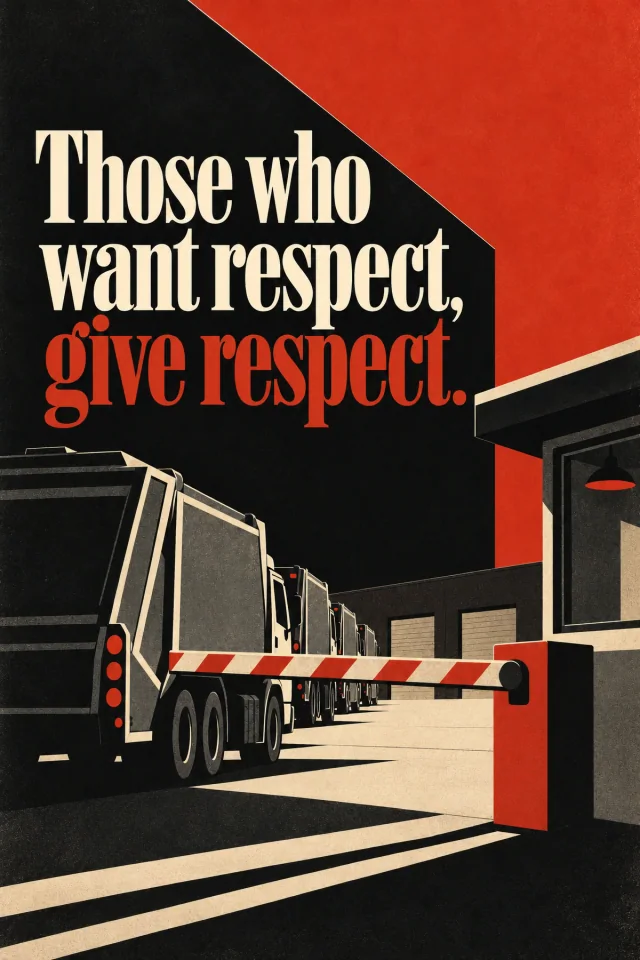
Spoken by Tony Soprano
controlled routes
Tony Soprano in The Sopranos’s “The Knight in White Satin Armor”: Tony penalizes Richie over cocaine dealing on garbage routes. Jackie Jr. appeals to his father’s legacy as a reason to respect Richie. Tony answers with reciprocity; Richie interprets the reply as a rebuke to both himself and his nephew. Claimed mutual respect is spoken from a position of authority. A garbage-truck queue is stopped by a striped barrier controlled from a dominant booth. The illustration interprets the exchange rather than recreating its literal staging.
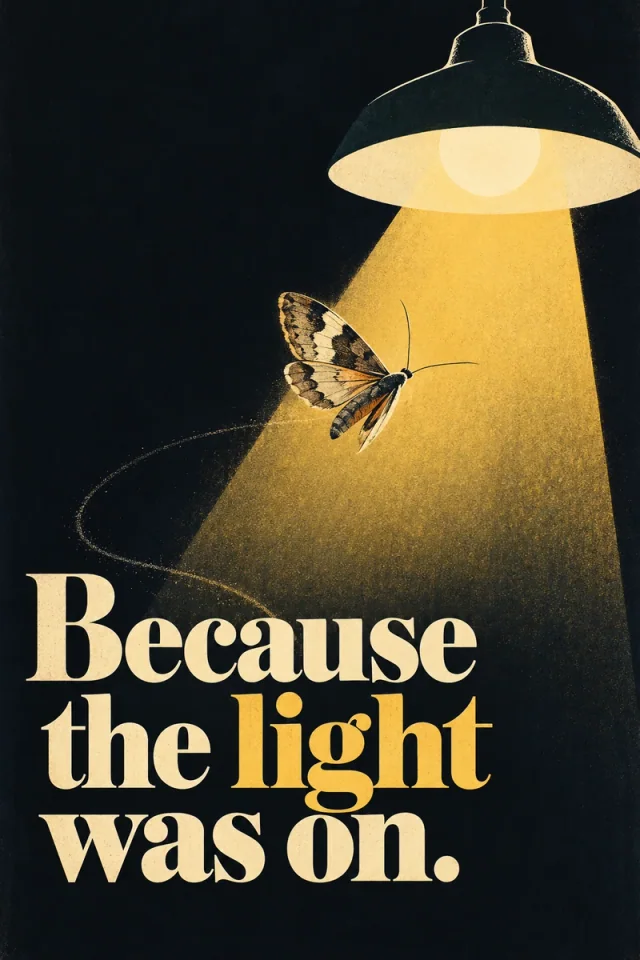
Spoken by Norm Macdonald
Single moth
Norm Macdonald in Norm Macdonald: A moth gives a podiatrist a long account of despair. The podiatrist observes that these problems call for a different kind of doctor and asks why the moth came here. The punchline abruptly replaces the psychological explanation with ordinary insect attraction to a lit place. Norm's own interview corroborates the short punchline and its extended delivery. No literal office arrangement is established. A lone moth beneath a hanging lamp, its golden cone of light breaking into a dark field beside cream serif lettering.
Inspired by Norm Macdonald
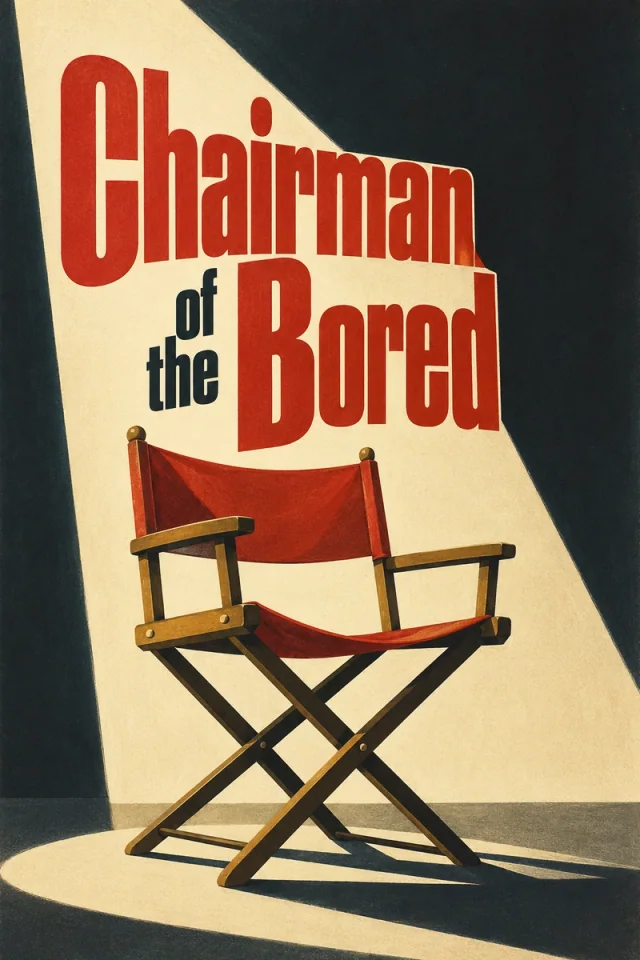
Director’s chair
Norm Macdonald in Norm Macdonald: Courtney Thorne-Smith is promoting her film Chairman of the Board. Conan invites Norm to respond to the title after his earlier barbs about the project. Norm turns the homophone into a bored spelling joke, puncturing the expected movie promotion. Team Coco's participant recollection establishes the interview; a dialogue record corroborates the spelling joke. The printed title is the user's approved adaptation, not a verbatim full utterance. An empty red director’s chair under a theatrical spotlight, with oversized red and black lettering on cream.
Inspired by Norm Macdonald
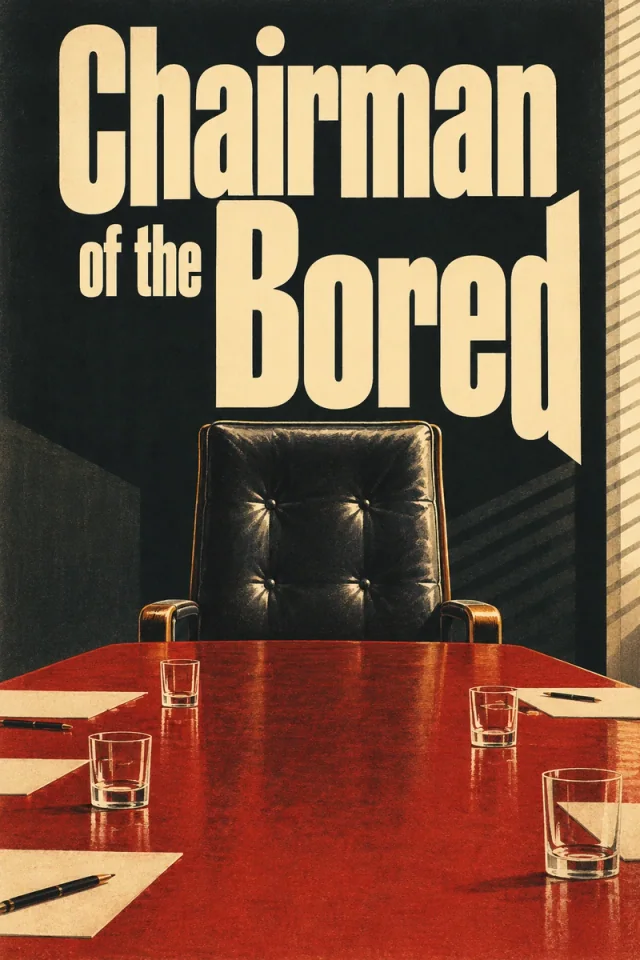
Empty boardroom
Norm Macdonald in Norm Macdonald: Courtney Thorne-Smith is promoting her film Chairman of the Board. Conan invites Norm to respond to the title after his earlier barbs about the project. Norm turns the homophone into a bored spelling joke, puncturing the expected movie promotion. Team Coco's participant recollection establishes the interview; a dialogue record corroborates the spelling joke. The printed title is the user's approved adaptation, not a verbatim full utterance. An empty black chair at a long red boardroom table, with tall cream lettering against a dark wall.
Inspired by Norm Macdonald
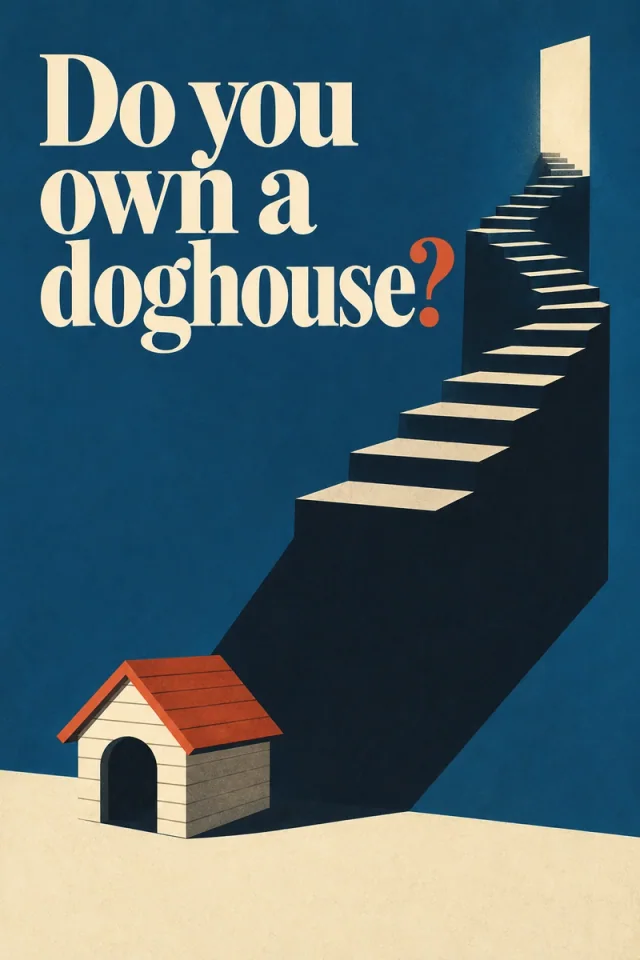
Impossible stairs
Norm Macdonald in Norm Macdonald: Norm tells a story in which a professor uses doghouse ownership as the starting point for increasingly personal inferences. The narrator then repeats a crude inference to someone else, treating absence of a doghouse as evidence of a conclusion that does not follow. The selected Norm clip's fan archive identifies a neighbor followed by a stranger at a bus stop; a circulating train version differs and is not being used. Do not picture unsupported literal staging. The user approved this exact short question, not the full punchline. A small red-roofed doghouse below an exaggerated rising stair and cream lettering on blue.
Inspired by Norm Macdonald
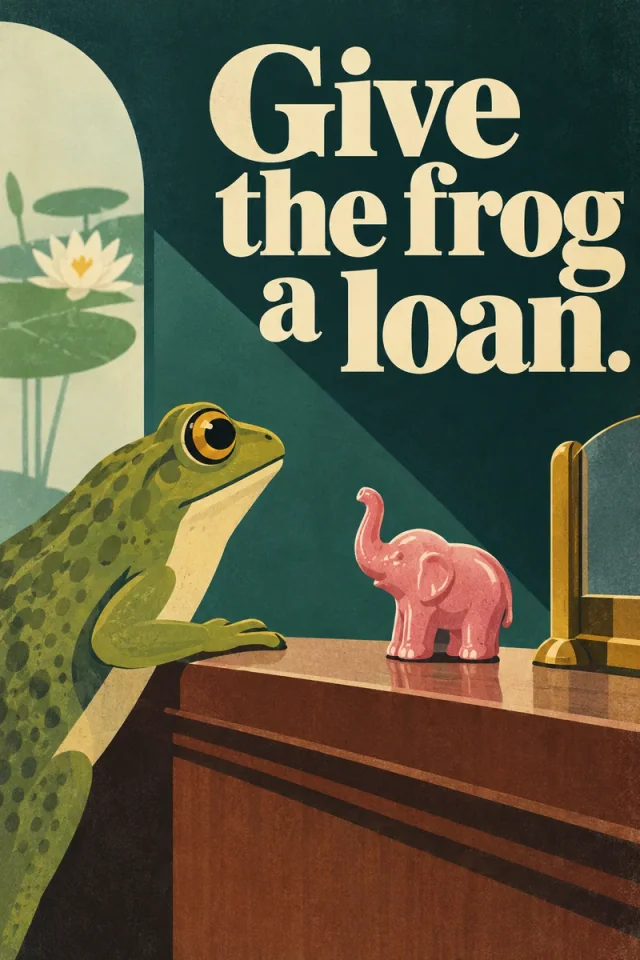
Bank counter
Norm Macdonald in Norm Macdonald: A frog asks a bank for a loan for a lily pad. The teller is Patty Whack, and the frog presents a shiny pink elephant trinket as collateral. The teller does not know what to make of it and consults the manager; the manager recognizes a knick-knack and authorizes the loan in the rhyming payoff. Performance-page automatic captions retrieved in the earlier source review establish these story elements; manually listened audio is not claimed. The printed line is the user-approved short excerpt, not the full rhyme. A green frog at a wooden bank counter beside a pink elephant trinket, with cream serif lettering above.
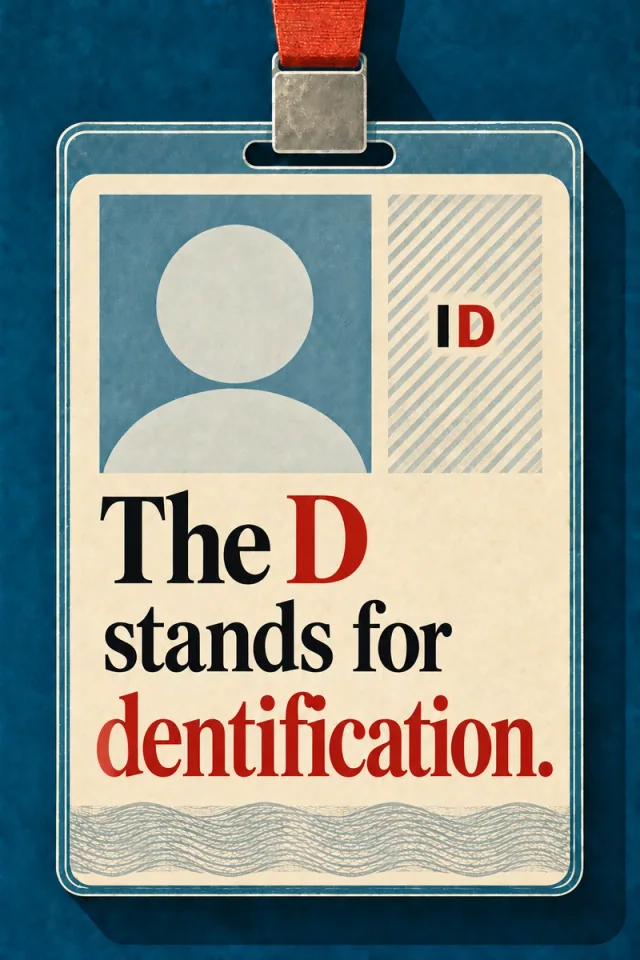
Inspired by Norm Macdonald
Balanced ID card
Norm Macdonald in Norm Macdonald: Norm questions ID as an abbreviation for identification: the I represents only itself while the D is made to stand for almost the whole remaining word. Norm's published interview directly supports the I/D split; Stern's primary page identifies the same joke in Netflix's teaser. The exact short printed formulation is user-approved abbreviated/adapted wording. Do not claim a specific special's exact delivery or timestamp. A cream identity badge on blue, with a small ID mark, blank portrait symbol, red lanyard and balanced black/red serif quote.